You're in for a special treat in two installments! HPPA board member of long standing, Donna Barr, has a deep connection to American Sāmoa and Sāmoa, traveling back and forth and investing a good part of her life in that island nation. We benefit enormously from having her on our board for that and many other reasons. Donna is a writer, too, with a published book about her time in the Peace Corps in then-Western Sāmoa. Please enjoy this first part of a two-parter blog that Donna was kind enough to write for all of us.
Part Two will post in two weeks.
*
In addition to my love for all of Hawaii’s national parks, one of the reasons that I joined the Board of Directors of the Hawaii Pacific Parks Association is my particular interest in our park partner the National Park of American Sāmoa. I first visited the park in 2008 when I was a volunteer with Peace Corps in Sāmoa (formerly Western Sāmoa), only a thirty-minute flight from the other end of the archipelago. Imagine my delight when Peace Corps placed me in the home of the Superintendent of O Le Pūpū Puʻe, Sāmoa’s first national park founded in 1978, and the first national park in the South Pacific islands. The park was only two miles down the road from my Sāmoan village! (In 2023 I wrote a blog post about the unique and amazing National Park of American Sāmoa - https://www.hawaiipacificparks.org/blog/115-three-weeks-in-Sāmoa-by-guest-blogger-donna-barr).
Sāmoa is made up of two main islands, Upolu and Savaiʻi, along with several smaller islands. The national park is a wedge of island habitats on the southern coast of Upolu. The park’s name describes its magnitude. From O Le Pūpū – the massive lava cliffs endlessly battered by wind, sea, and salt – to Mount Le Puʻe (3,373 ft). The rocky mountainous backbone continues to Mount Fito (3,608 ft), the second-highest mountain on Upolu, sitting just 10 meters shorter than nearby Mount Vaivai. Covering 11,519 square miles, the park encompasses a diverse range of ecosystems, including upland and lowland forests bisected by deep valleys, marshlands, and coastal cliffs.
O Le Pūpū Puʻe National Park is home to two montane herbaceous marshes as well as parts of the Mataloa and Saʻaga Rivers, and has been designated a Ramsar site, a wetland area of international importance under the Ramsar Convention to promote the conservation and wise use of wetlands worldwide. Here in the national park, the island’s best-preserved remaining tropical forest is part of the Queens Commonwealth Canopy, a network of forest conservation programs throughout the Commonwealth of Nations endeavoring to save one of the world’s most important natural habitats.
Starting at the small Visitor Center and gardens, a network of trails fans out, ranging from easy strolls to challenging day hikes. with informational signs highlighting areas to explore, conservation endeavors, and efforts to protect native flora and fauna – including the newest signage commemorating King Charles’ visit to the park in 2025 when His Majesty attended the Commonwealth Heads of Government Meeting in Sāmoa.
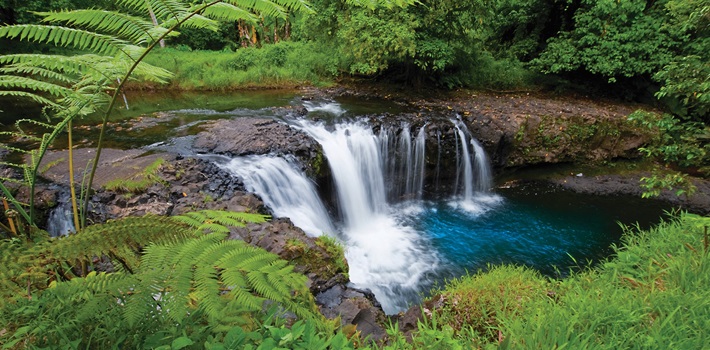
It’s a short walk (1,150 feet) from the Visitor Center under the rainforest canopy to the cascading pools of Togitogiga Falls. Along the way colorful fruit doves coo, or the endangered Tongan fruit bat may be roosting or soaring above. It’s told that in these cool waters the legendary warriors of ancient Sāmoa would bathe, relax, and condition themselves after battles or rigorous training. The forest path continues to the Peʻapeʻa lava tube cave about a one hour walk through the jungle. Hiring a local guide is recommended on this leg of the trail, as tourists tend to get lost! The cave was named after the peʻapeʻa (white-rumped swiftlets) which sing from its depths.
Hardy hikers can start on the six-to-eight-hour round trip walk from the trailhead near Papapapaitai Falls along the South Island Road, trekking along the slopes of Mount Puʻe to the cloud forest atop Mount Vaivai. Here you can hear the wailing call of the maʻomaʻo, the forest honeyeater, and on a clear day, see sweeping views of both north and south sides of Upolu Island.
I enjoy this park so much whenever I visit Sāmoa that I have more to say about it! Next time: another stunning walk to the coast and the unique blend of conservation and culture in O Le Pūpū Puʻe, Sāmoa’s treasured national park.
*
Learn about the O Le Pūpū Puʻe National Park.
Learn about the National Park of American Samoa.
Shop the National Park of American Samoa.